Martin Niemöller, a Lutheran minister, began as a supporter of the Third Reich during the rise of Nazi Germany. It was easy. It was understandable. It was acceptable, but there was a danger of ignoring injustice
Germany—and much of Europe—was emerging from the ravages of the Great War (later called the First World War). They were difficult years. People were desperate for peace—any peace.
The Bolsheviks (read: socialists), and later the Jews, became convenient scapegoats. Antisemitism reached a fever pitch in the mid-1930s. When the Gestapo began night raids and banned groups and individuals, many people tacitly approved.
Martin Niemöller was one of them.
In time, the regime began the Nazification of the churches. Niemöller, along with other pastors, protested—but by then it was too little, too late.
For their resistance, Heinrich Himmler had them arrested and thrown into concentration camps, alongside the very people they had once ignored.
Niemöller spent seven years in captivity.
A Confession Born of Guilt
After the war, and perhaps in an effort to confront the guilt gnawing at their souls, German church leaders issued the Stuttgart Declaration of Guilt:
“Through us infinite wrong was brought over many peoples and countries… we accuse ourselves for not standing to our beliefs more courageously, for not praying more faithfully, for not believing more joyously, and for not loving more ardently.”
It was a sobering admission—not just of what they had done, but of what they had failed to do.
The Famous Warning
Yet Niemöller is most remembered for his haunting lament:
First they came for the Socialists, and I did not speak out—because I was not a Socialist.
Then they came for the Trade Unionists, and I did not speak out—because I was not a Trade Unionist.
Then they came for the Jews, and I did not speak out—because I was not a Jew.
Then they came for me—and there was no one left to speak for me.
A Kenyan Mirror
Now bring it home.
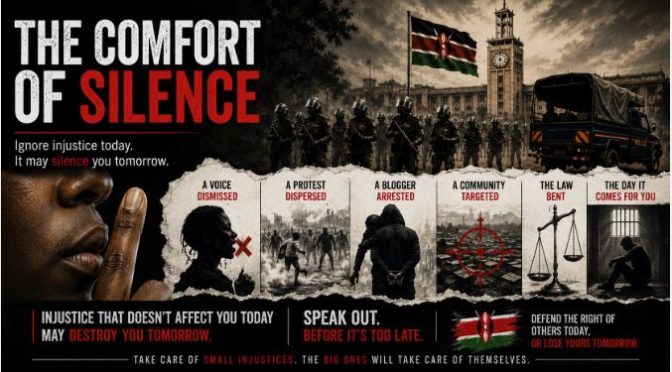
When a blogger is picked up by hooded people in the night, we say, “He must have crossed a line.”
When the police tear-gas protesters, we say, “They should have stayed peaceful.”
When a community is profiled, harassed, or collectively punished, we whisper, “Those ones…”
When a procurement rule is bent, we call it “facilitation.”
When public funds disappear, we shrug, “That is how things work.”
When institutions are weakened, we console ourselves, “At least it is not affecting me.”
We have learned to rationalise small injustices—especially when they do not knock on our door.
The Slow Breaking of the Law
But the law does not bend forever.
Each exception creates a precedent. Each silence grants permission. Each compromise shifts the boundary of what is acceptable.
Today, it is your political opponent.
Tomorrow, it is a distant community.
Soon, it is anyone’s inconvenience.
And eventually—it is you.
The Question We Cannot Avoid
Is there an injustice you are excusing because it serves you, or harms someone you do not care about?
What excess are you tolerating because it wears the uniform of your side?
Because when the rules become optional, they do not remain selectively optional. They collapse. And when they collapse, you will have no law left to appeal to—only power.
The Weight of Small Injustices
Niemöller’s mistake was not that he supported evil outright. It was that he tolerated it in increments.
So we return to a simple truth:
Take care of the small injustices, and the larger ones will take care of themselves. Ignore them, and one day, like Niemöller, you may find there is no one left to speak for you.