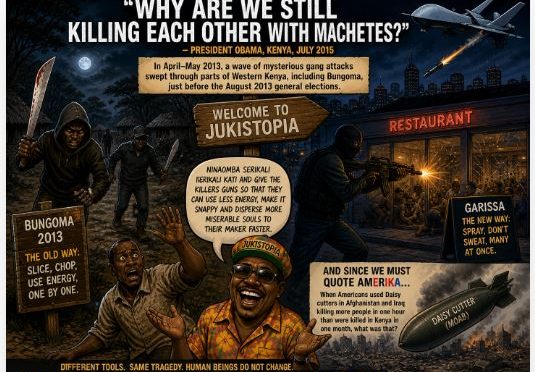
In April and May of 2013, a strange kind of fear settled over parts of Western Kenya. In Bungoma, night did not just bring darkness—it brought footsteps. Groups of young men, faceless and wordless, would descend on homes armed with crude weapons: machetes, clubs, axes. They did not come to steal. They came to maim, to kill, to leave behind questions. The mayhem was known as the Bungoma Killings.
It was a wave. Not isolated. Not random. Coordinated in its mystery.
This was just months before the Aughust 2013 general election, though the shadows stretched well into that political season. Nobody quite claimed responsibility. Nobody convincingly explained it. And like many Kenyan things, it dissolved into silence before it was fully understood.
Then, in July 2015, Barack Obama visited Kenya and asked a question that sounded simple, but landed heavy:
“Why are we still killing each other with machetes?”
He meant it as a rebuke. A lament. A frustration. In a modern world of constitutions, courts, and ballots, why were people still resolving disputes with pangas?
But in Jukistopia, we heard something else.
Not outrage—comparison.
Because when you listen carefully, the question begins to sound less like why are you killing and more like why are you killing like this?
And suddenly, the problem is not the killing.
It is the method.
The Hierarchy of Death
In this interpretation, Bungoma’s killers are not the worst. They are simply… inefficient.
In Garissa, attackers do not hack—they spray. Bullets. Fast. Industrial. Modern. One pull of a trigger and many lives collapse at once. Efficient. Scalable. Almost… sophisticated.
Bungoma, by contrast, feels primitive. Personal. Labor-intensive. Each life taken requires effort, proximity, sweat. It is violence that still breathes heavily.
Jukistopia had never seen it that way before.
Impressive, really.
A Modest Proposal
If the issue is efficiency, then surely there is a solution.
Ninaomba serikali iingilie kati.
Let the government step in—not to stop the killing (that would be too ambitious), but to modernise it.
Equip the killers with guns.
Why waste energy? Why struggle through the night hacking when technology has already solved this problem? Let it be quick. Snappy. Clean. A more humane dispatching of souls to their Maker.
After all, progress must mean something.
And Since We Must Quote Amerika
Because no serious discussion is complete without invoking America, let us widen the lens.
When the United States deployed Daisy cutters in Afghanistan and Iraq—massive bombs capable of flattening entire areas—killing in an hour what Kenya might not lose in a month, what was that?
Was it barbarism? Or was it simply advanced machete work? Scaled up. Industrialized. Sanitised through distance and altitude.
No blood on hands. Just coordinates and confirmation.
So, What Was Obama Asking?
Maybe the real discomfort is this:
We like to believe there is a difference between a machete and a missile. Between a village attack and a drone strike. Between Bungoma and Baghdad.
But strip away the language, the uniforms, the technology—and what remains? People killing people. Some with pangas. Some with policy.
In Jukistopia
We do not reject Obama’s question. We just tilt it slightly.
Why are we still killing each other with machetes?
Or better yet:
Why are we still pretending the machete is the problem?
Because if history has taught us anything, it is this: Human beings do not stop killing when they become modern. They just become more efficient at it.