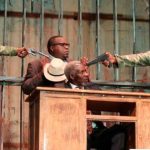
Not too long ago, I met Abunuwasi in Jukistopia. His visit coincided with a time when stories of money disappearing at NYS filled the air. People were angry. The accused were defensive. The accusers were loud. Yet, strangely, it was not long before the acusers and the accused were seen heartily laughing together, sharing spaces, even defending each other. Meanwhile, the people cheered and clapped, all anger completely forgotten. But not all of them.
See also the National Youth Service Monkeyshine
A few bothered people asked Abunuasi what he could make of this cunundrum.
Abunuasi only smiled and said, “Let me tell you a story.”
A wash-wash charlatan, escaping a near-lynching in a big city, fled into a quiet village called Kenia. There, he quickly noticed two things: one, the villagers were guilable and eager for quick fixes, and two, there was no prayer leader among them.
Opportunity.
Quickly, the charlatan clothed himself in a kanzu, learned a few Arabic-sounding phrases, and convinced the good people of Kenia prayer was their solution. They appointed him their prayer leader, despite knowing nothing about faith or prayer.
But he knew performance.
Every morning, he would shout, “Allahu akbar!”—a phrase he had memorised from the city. The villagers, unsure but eager to solve their problems, moved closer in silence. That was his opening.
He stepped closer and instructed them:
“Hakuna madhabahu bila dhabihu—there is no altar without sacrifice.”
meaning, every time they came to pray, they were to bring offerings. At every chant, they would respond “Amin” and deposit their sacrifices into a large basket at the front.
Day after day, the basket filled. Day after day, the charlatan prospered.
Until one day, trouble walked in.
Enter the swindler
A second visitor from the city entered the mosque. The charlatan froze. He recognised him immediately—a fellow swindler, and worse, one of the men who had nearly lynched him before he fled.
The feeling was mutual as the swindler began walking toward the charlatan menacingly.
Thinking fast, the charlatan raised his voice:
“Allahu akbar!”
“Amin!” the people responded.
Then, mixing fear with improvisation, he continued:
“Mwenzangu usinitambue, Wajinga ndio waliwao, amin.
Nikipata nane, nne zangu na nne zako, amin!”
(My friend, do not expose me. Fools are meant to be conned.
If I get eight, four are mine, and four are yours.)
“Amin!” the villagers thundered, unaware.
The approaching swindler paused… then smiled.
In a pious tone, he responded:
“Amiina mwenzaaangu… nne zangu na nne zako…
Aaamiiina, allahu akbar! Tu mandugu sasa.”
(Amen my friend… four for me and four for you…
Amen, God is great! We are now brothers.)
The Swidler knelt beside the charlatan and became his helper in leading prayers
From that day on, the two men led prayers together. Their past conflict dissolved into a partnership, and the people of Kenia kept bringing offerings.
Abunuwasi ended the story there.
But the lesson lingered.
In Jukistopia, we often believe scandals are battles between enemies—accuser versus accused, informer versus thief. So we pick sides. We argue. We rage.
Yet, too often, those we think are fighting are merely negotiating and soon reach an agreement.
What begins as an accusation ends in accommodation, conflict ends in sharing, and what sounds like justice becomes choreography.
Like the villagers of Kenia, we keep saying “Amin”—even as the basket is passed