I have delivered a jeremiad to all who care to listen about the August 8, 2017, elections. I have said—without hesitation—that they risk being the worst, or at the very least the most useless, since the infamous 1988 exercise. What has unsettled me, however, is not disagreement—but the election rigging amnesia.
Two out of every three people I speak to ask me, quite innocently, “What was wrong with the 1988 elections?”
And I pause.
Is it that long ago? Or have we simply chosen to forget?
Let me remind you.
Thin line between the government and the KANU Political Party
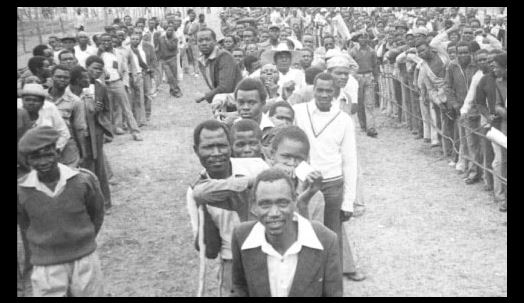
The 1988 elections were, in truth, not elections as we understand them today. They were nominations under the one-party state of KANU—because KANU was the only legal party. What followed has since entered our political vocabulary as mlolongo voting—queue voting.
Citizens did not cast secret ballots. There were no booths, no privacy, no dignity. Instead, at polling stations, agents held aloft portraits of candidates. Voters—all voters, because party membership was indistinguishable from citizenship—were required to line up physically behind the agent of their preferred candidate.
Your vote was not just public; it was performative. It was not merely a choice—it was a declaration. And, more dangerously, it was a test of loyalty.
This system was not an accident. It was engineered under the watch of the Nyayo era, associated with Daniel Arap Moi, to separate the “loyal” from the “suspect.” These were not just nominations—they were purges, euphemistically referred to as uchaguzi wa mchujo—elimination elections.
But the real obscenity lay deeper.
Elected unopposed.
Candidates who secured 70 per cent of the vote at this queue stage were declared elected outright—without proceeding to the general election. Parliament was, in effect, decided in schoolyards and open fields, under the watchful eyes of local administrators and party operatives.
And yet, the final list that arrived in Nairobi bore only a faint resemblance to what those queues had suggested.
Results were not just influenced—they were rewritten.
It was a perfect system for chujaring—weeding out those who were not “KANU damu,” not sufficiently loyal, not sufficiently compliant.
Figures associated with the KANU disciplinary committee —names like Okiki Amayo, Joseph Kamotho, and Peter Oloo Aringo—were not merely administrators. They were enforcers of conformity in a system that feared dissent more than it valued democracy.
That was 1988.
Now, decades later, we stand on the brink of another election. The methods are more sophisticated, the language more polished, the institutions more elaborate. But the underlying anxiety remains: what if the outcome is determined long before the first vote is cast?
Results Decided in Advance
What if the choreography has already been written?
When institutions are weakened, when oversight is compromised, when political survival trumps democratic integrity, elections risk becoming ritual rather than choice—performance rather than participation.
And so, when I say that 2017 risks echoing 1988, I do not mean we will queue behind portraits again. I mean something more subtle—and perhaps more dangerous. An election need not be visibly flawed to be fundamentally hollow.
It only needs to be decided in advance.